How OMEGA Is Rethinking Precision With The New Constellation Observatory


There is an observatory on the back of every Constellation. Small enough to sit beneath a sapphire crystal, it has appeared there in one form or another since 1952. Observatory trials were once among watchmaking’s most esteemed tests of accuracy. Brands submitted their finest movements and reputations were forged on results measured in fractions of a second. OMEGA’s Constellation has long defined that pursuit.
The new Constellation Observatory collection builds on that history with nine new references housed in a 39.4mm case. At first glance, much of it will feel familiar. The dodecagonal pie-pan dial returns, as do the faceted dauphine hands, kite-shaped indexes, dog-leg lugs, and the Constellation star at six o’clock. The collection is available across O-MEGASTEEL, Sedna Gold, Moonshine Gold, and Canopus Gold, alongside a flagship Platinum-Gold model that brings together all four of OMEGA’s proprietary precious metal alloys for the first time. The real story, however, lies beneath the dial.
Technical virtuosity
The collection is the first two-hand watch family to achieve Master Chronometer certification. That distinction may sound technical, but it represents a significant shift in how precision is measured. For decades, certification relied on the presence of a seconds hand. Its movement provided a visual reference point through which performance could be monitored and recorded. Remove it, and the traditional methodology no longer works in quite the same way. Rather than redesigning the watch, OMEGA chose to redesign the test.

The breakthrough comes from the Laboratoire de Précision, the independent testing facility established by OMEGA in Biel in 2023. There, the brand developed what it calls Dual Metric Technology, a wireless testing system that combines Chronometer and Master Chronometer certification within a single device. Over a period of 25 days, the system continuously records the acoustic signature of the movement while simultaneously monitoring position, temperature, atmospheric pressure, and magnetic exposure.
Traditional testing methods generated individual measurements at specific intervals. Dual Metric Technology produces a continuous stream of data from the first second of testing. By analysing the sound of each ‘tick and tack’, watchmakers can identify frequency irregularities, amplitude fluctuations, positional variation, and environmental sensitivities, pinpointing not only that a deviation has occurred, but exactly when and under what conditions. Consequently, this level of precision testing no longer requires a seconds hand at all.
Two new Master Chronometer calibres
To mark the occasion, OMEGA has developed two new Master Chronometer calibres specifically for the collection. Calibre 8914 powers the four O-MEGASTEEL references, while Calibre 8915 is reserved for the precious metal models. Both are built around a skeletonised rotor architecture with an applied Observatory medallion, though the execution varies according to the collection’s three tiers: Grand Luxe, Luxe, and Standard.
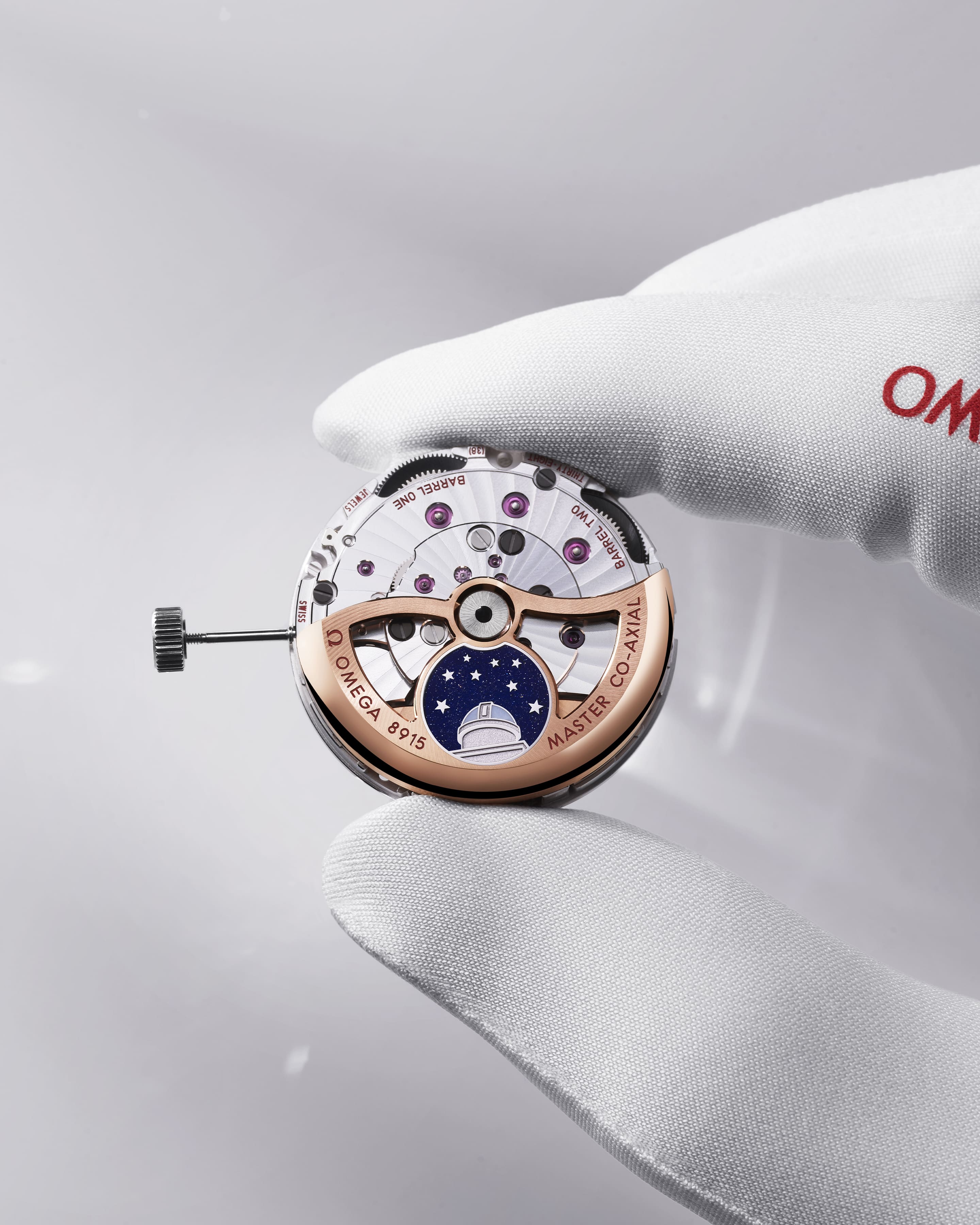
The precious metal watches are where the distinctions become most apparent. Calibre 8915 Luxe introduces the first 18K Moonshine Gold rotor and balance bridge in OMEGA’s history, alongside Sedna Gold finishing and Geneva waves in arabesque across the rotor. The Platinum-Gold model takes matters further still. Its Calibre 8915 Grand Luxe features a Sedna Gold rotor base and a white gold Observatory medallion set against an aventurine-glass sky, complete with eight stars and an observatory dome rendered in translucent opal enamel.
Material innovation continues elsewhere in the collection. The O-MEGASTEEL references include a black ceramic pie-pan dial whose sharply faceted geometry required extensive development to achieve in ceramic, alongside coloured dial options featuring stamped groove facets. The precious metal models, meanwhile, pair hand-guilloché dials with matching cases and movements, creating a remarkably cohesive expression of each alloy.

For all the innovation beneath the dial, the Constellation Observatory remains true to the collection’s original purpose. The observatory still sits on the caseback, only the methods used to pursue its ideal have evolved.
Image credits: Respective Brands