The Integral and Rado’s Material-First Thinking
%20(1).png)

Watch history is usually told through movements, but the case does just as much to define the object over time. Materials determine weight, surface integrity, and how a watch holds up on the wrist after years of wear. That has been a consistent line of inquiry for Rado since the 1960s, with development centred on hardness and durability at the level of the case itself. The Integral, introduced in 1986, sits at a key inflection point, when high-tech ceramic shifted from an experimental material to a core element of watch design.
The story begins in 1962 with the DiaStar Original. Its Hardmetal case—a tungsten-carbide alloy—was developed for scratch resistance at a time when steel showed wear quickly. The rounded form stood apart, but the real shift was material. Durability became a design principle. Development followed the same logic. Instead of beginning with form, projects started with material behaviour. By the late 1970s, that thinking led Rado towards high-tech ceramic: lighter than steel, adaptable in finish, and highly resistant to wear.
Master of Materials
High-tech ceramic begins as zirconium oxide powder, injected into moulds and sintered at roughly 1,450°C. The process produces a dense, non-porous material with high surface hardness. Rado introduced this material language through the DiaStar Anatom in 1986, soon renamed Integral. The name described the structure. The case, bracelet, and sapphire crystal were conceived as a continuous form. The bracelet made that idea visible. Steel outer links framed ceramic centre links, extending into the case without interruption. The watch reads as a single object. Ceramic also changed how the watch wore—lighter than steel, neutral against the skin, and resistant to the surface wear that typically accumulates over time.
RADO Integral
The Integral’s evolution has been steady, shaped by material rather than form. The 1990 Ceramica extended the concept into a fully ceramic construction. The 1992 Coupole introduced white high-tech ceramic, while the 1997 DiaQueen marked the arrival of plasma ceramic, expanding tonal depth. As the material matured, its applications became more precise. The 2005 Sintra explored colour with greater nuance. The 2011 True Thinline reduced ceramic to a slimmer profile. The 2021 Captain Cook High-Tech Ceramic introduced skeletonisation within the material framework, and the 2025 Anatom returned to the original ergonomic focus in plasma ceramic.
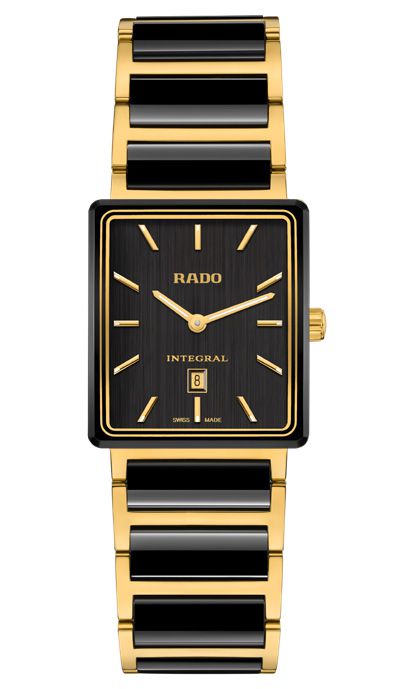
The 2026 Integral Anniversary collection consolidates this development into a single, resolved form. The case is sized at 28.0 × 39.8 mm with a thickness of 7.3 mm, powered by the calibre R279 quartz movement with a date at six. A vertically brushed black dial is set with 12 luminous indices, while the curved sapphire crystal retains its signature golden frame, now refined with a bevel and anti-reflective coating. The bracelet tapers more precisely, maintaining the steel and ceramic construction that defines the line.
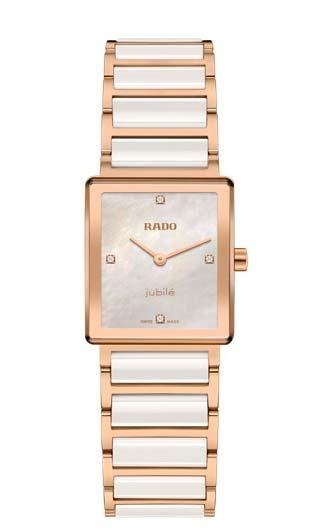
Across the collection, nine references map this evolution in detail. The smaller-format models range between 23 × 32.7 mm and 23 × 33.4 mm, with diamond-set variations and mother-of-pearl dials, introducing shifts in light and colour. The larger models extend to 31.5 × 44.5 mm, offering a broader wrist presence while retaining the same ceramic-steel architecture.
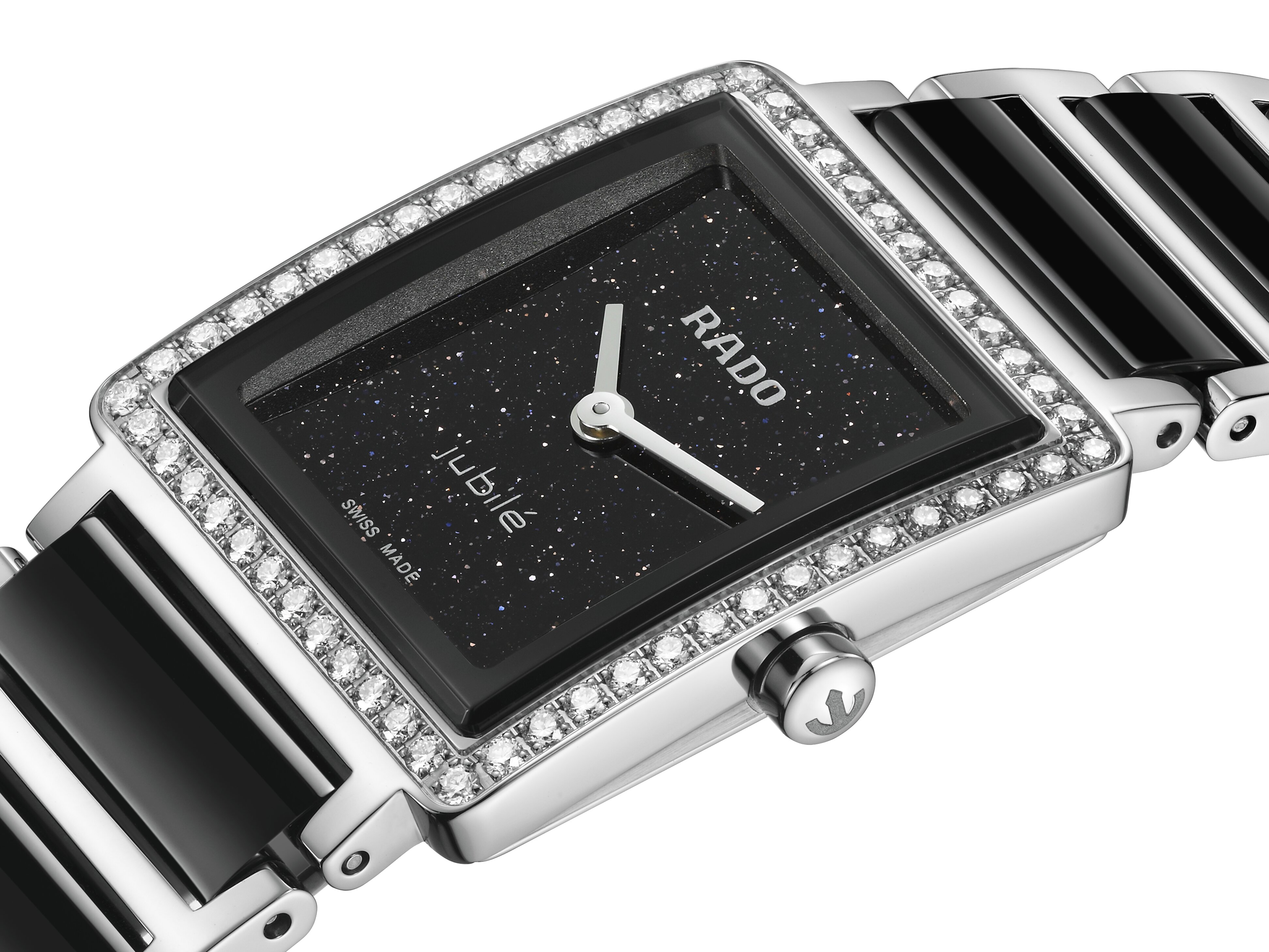
At the center of the Anniversary collection sits the Jubilé, set with 56 Top Wesselton diamonds, frames the dial with a level of precision that heightens the Integral’s original design without altering its structure. It anchors the collection as the most complete expression of the anniversary, where material, construction, and finish converge within the same integrated form.
The Performance Equation
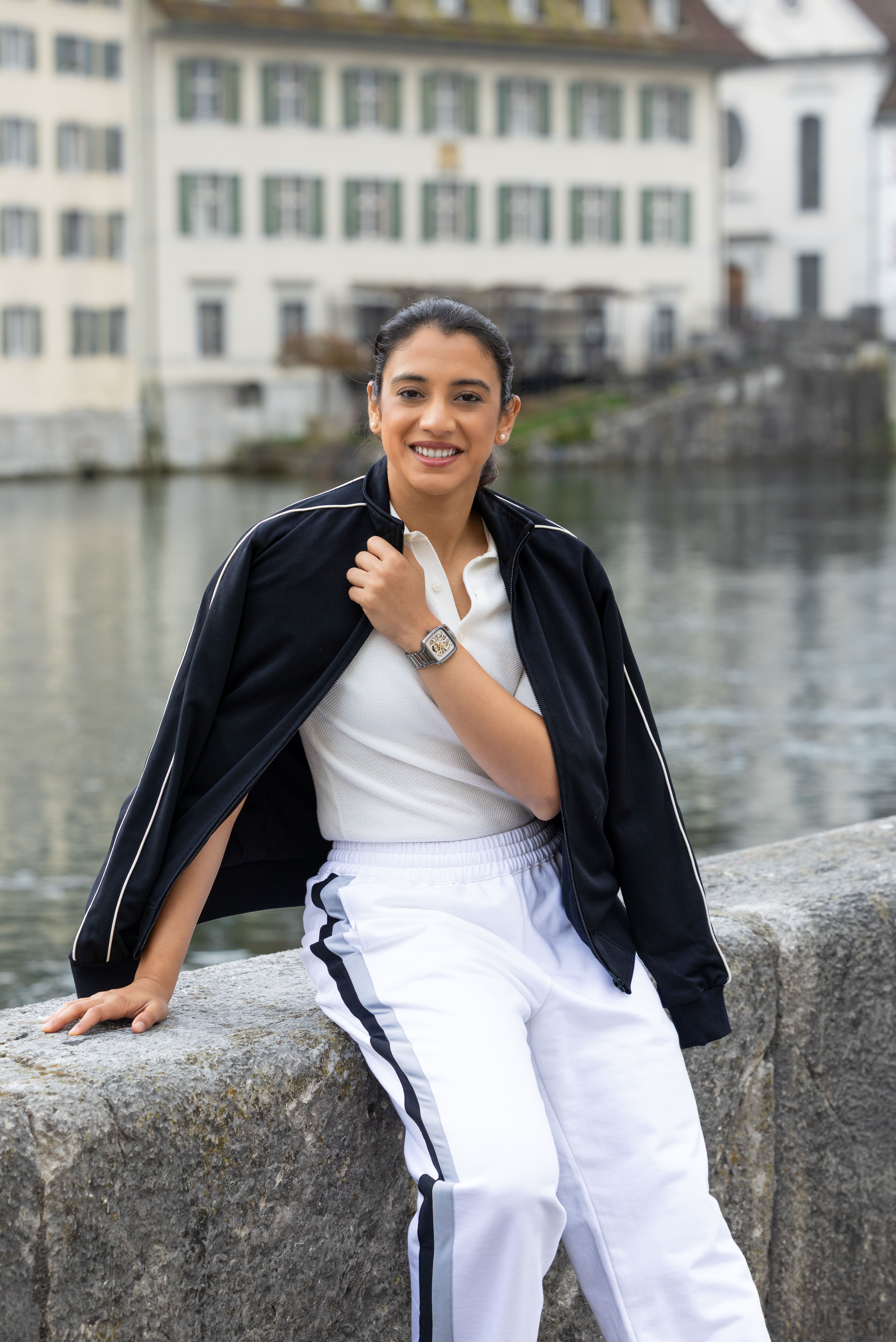
As the brand marks 40 years of high-tech ceramic, Rado has named Smriti Mandhana as a Friend of the Brand, reinforcing its longstanding connection to cricket. Her approach to the sport, defined by timing and precision, mirrors the same principles that underpin Rado’s material-first watchmaking. During her recent visit to Switzerland for the anniversary, she wore the True Square Open Heart, a model that reveals its inner structure through an openworked dial, reflecting the balance between performance and design that defines both fields.
Forty Years On
The Integral remains defined by its original premise. The case and bracelet still read as a continuous system, while ceramic continues to anchor the construction. Four decades of development have refined the material and adjusted proportions, but the underlying idea holds. The watch tracks time, but it also reflects how material innovation shapes the object itself.
Image credits: Respective brands